
Deadline for application: 16 November 2026
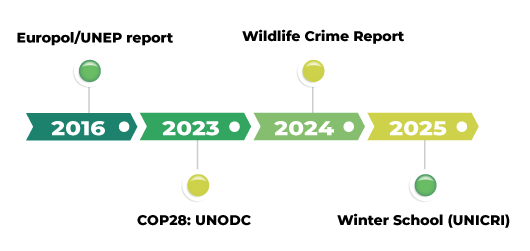
Due to climate change, environmental preservation and defense have become a priority in the UN strategy to reach the 2030 Agenda Sustainable Development goals. The Agenda highlights that environmental degradation's negative impacts are one of the century's wicked challenges together with environmental depletion. At the Conference of Parties 28 of 2023, UNODC evidenced the need to address environmental crimes to endorse climate change mitigation. For an immediate global response to reach the SDGs, it encouraged a strong justice commitment and cooperation among Member States to fight environmental crimes.
Ahead of time, since 2016, according to the joint strategic report of the EUROPOL and the UNEP “The Rise of Environmental Crime” (2016), violation of the environment is nowadays the fourth largest criminal offense worldwide. This phenomenon has notably increased, and it is expected to expand all over the world in the next years due to the unfolding transnational criminals. Member States and international organizations are urgently working to avoid this crime commitment and to educate people on the consequences of exposure. Indeed, as a transnational crime activity, people and groups of people are benefiting from damaging the ecosystems and their inhabitants.
In the 2024 World Wildlife Crime Report, one of the key messages highlights the strict interconnection between wildlife crimes and organized crime. As this type of crime is one of the activities taken in place by large, organized transnational crime groups, it requires a complex and broader strategy that should intervene on these groups.
With these considerations in mind, UNICRI and the Italian Society for International Organization (SIOI) are organizing the tenth edition of the Winter School on Environmental Crimes, which will be delivered online, from 30 November to 4 December 2026.
The course will provide participants with a fundamental understanding of what environmental crimes are and how law enforcement bodies and judicial systems are responding. The Winter School contributes to advancing and promoting justice by raising awareness on this topic. For the participants, identifying the different forms, offenders, and acts of eco-crimes is the first step in the advocacy path. People's vulnerability is less threatened when individuals advocate for an effective change in public policies, strategies, and practices.
As it cannot exist sustainable development within a society threatened and not healthy and inclusive, the Winter School is delivered in a multidisciplinary and comprehensive approach. The existing international legal framework will be examined to improve participants’ ability to comprehensively address the issue. More specifically, the curriculum of the course may focus on:
- Existing international legal frameworks to prevent crimes against the environment.
- Environment and illegal mining.
- The concept of environmental protection and its evolution.
- Environmental crimes and terrorism.
- Involvement of organized criminal groups in environmental crimes.
- Waste trafficking and its impact on human health and security.
- Wildlife crimes.
- Environmental conflicts and justice.
- Individual, corporate and State accountability for environmental crimes.
The Winter School offers professional, legal, social, scientific, and academic perspectives through live webinars, group discussions, dynamic case studies, individual readings, and practical exercises. The faculty is composed of leading scholars and academics from leading universities, representatives of the United Nations system, international human rights bodies, and civil society.
Through a dedicated online platform, participants will have the opportunity to interact with internationally recognized experts and peers from all over the world, so to build lasting professional relationships. This experience fosters intercultural dialogue and promotes a deeper understanding of some of the world’s most complex and debated issues.
Relevant information
| Dates | 30 November – 4 December 2026 |
| Venue | Online |
| Application deadline | 16 November 2026 (rolling basis) |
| Confirmation of acceptance | Within 1 week following receipt of the application |
| Payment deadline | Within 1 week following confirmation of acceptance |
| Contacts | UNICRI: unicri.courses@un.org | (+39) 06 6789.907 SIOI: formint@sioi.org | +39 06 6920781: (please indicate “Environmental Crimes" in the subject of the e-mail) |
1. Entry requirements
The course is intended for university and post-graduate students, Ph.D. candidates, media and other professionals, including United Nations (UN) personnel, as well as anyone interested in gaining a deep knowledge of current environmental crimes issues.
Candidates must meet the following minimum requirements:
Be enrolled in, or have completed, a first university degree program (minimum bachelor’s level or equivalent).
Possess a strong command of the English language.
2. Course Methodology
This course adopts an online learning model, allowing participants to attend interactive online classes through their own devices. This format enables direct interaction with internationally recognised experts and peers from around the world, fostering the creation of a global professional network. The program combines live training sessions in our virtual classroom, led by subject matter experts, with self-paced activities and interactive group discussions.
The live training sessions are conducted on a dedicated online platform. Participants need a computer (recommended) or a mobile device with audio and video capabilities, a headset with a microphone, and a reliable internet connection. We recommend accessing audio through the computer for the best experience; no special software is required. Upon acceptance to the course, participants will be provided with the necessary information to access the platform.
The live training sessions are scheduled from 2:00 pm to 6:00 pm Rome time (8:00 am to 12:00 pm New York time), from Monday to Friday. Please note that absences resulting from inadequate planning will not be considered justified. Participants who do not complete the online course will not be entitled to the certificate award, nor will they be eligible for refunds or reductions in the registration fee.
3. Certificate of participation
Upon attendance of all live webinars and completion of the course activities and assignments, participants will receive a certificate of participation jointly released by the United Nations and SIOI. The Organizers retain the discretion to consider severe reasons for absences when issuing the certificate.
4. How to apply
Application Procedure
- Online application via INDICO platform (UN):
Applicants are required to register on the INDICO platform of the United Nations and submit their application exclusively through the online system. PLEASE CLICK HERE. - Required documents:
During the application process, candidates will be required to:- upload a recent photograph (which can be taken directly through the platform using the website tools)
- upload a scanned copy of a valid passport or another valid identification document.
- Application deadline:
Applications must be completed and submitted through the INDICO platform by 16 November 2026. The selection is carried out on a rolling basis.
5. Selection and Acceptance:
- Confirmation of acceptance:
The outcome of the selection process will be communicated to applicants via e-mail within one week following submission of the application. Acceptance of the application:
Once the application has been reviewed and accepted, it will be formally registered in the system.Enrollment of the candidate:
The candidate’s enrollment will be finalised only upon receipt of full payment (see sections #6, #7 and #8)
6. Registration Fee
Registration fee amounts to 800 Euro.
Registration fee includes:
Tuition
Course material on electronic version
7. Payment
Payment deadline:
Upon approval of the application, the full payment must be completed within one week.Payment procedure:
Once your application has been approved, detailed payment instructions and the relevant bank details will be provided. Please note that payment may be made by bank transfer only.Proof of payment:
A copy of the payment receipt must be sent by e-mail to the following addresses:unicri.courses@un.org
8. Cancellation and Refunds
In the event of a participant cancellation for any reason, including visa denial, registration fees will not be refunded.